ПОВЕЙ, ВЕТРЕ - място под слънцето за Дистрибутирания
Отиди на страница:

| Калки А за колко години напред са сключени договорите по цени (преференции) от преди юни 2011-а ? Мисля, че беше 25 години и тогава го намалиха. Но не съм сигурен. В момента май за ВтЕЦ е 12 години, а за ФЕЦ е 20 години, ако някой знае да ме поправи. |
| дъртреалист Я-я, че то преференциите от 80 ст слезли на 20, почти крайната цена? Че тогаз защо тока пада само с 1.5%? Какво излиза, че не ФЕЦ са надували цената, или? Нееее  Не работи така работата. Това са новите преференции с които ще се сключват новите договори. Не работи така работата. Това са новите преференции с които ще се сключват новите договори. Например, ако сега един ВтЕЦ сключи на 13 ст/квтч ще му се плаща 12 години до 2025та все по 13 ст/квтч, защото е фиксирна цената. Демек, ако Р.Овч. ти каже, че тока от АЕЦ"Белене" ще струва 15 ст/квтч, това е по-скъпо от тока от въпросния ВтЕЦ, който и 2020та пак ще му изкупуваме тока за 13 ст/квтч. И ДКЕВР сменя само преференцията за новите договори, старите си седят. Така работят преференциите. | |
Редактирано: 1 път. Последна промяна от: Distributed |
| Ако правилно съм разбрал, една ФЕЦ, сключила договор през 2010-а, ще си получава по 80 ст/КВт до 2030-а. Май наистина токът от Белене е спасението .... |
| Калки Ако правилно съм разбрал, една ФЕЦ, сключила договор през 2010-а, ще си получава по 80 ст/КВт до 2030-а. Май наистина токът от Белене е спасението .... Абе щом виждаш в АЕЦ"Белене" спасението, май не си го разбрал правилно. Най-малкото не можеш да сключиш договор с преференция от 2011та. Новите преференции се сключват с текущите преференции, а не с тези от преди 5-10 години. Всъщност до юни.2011та на въпросните 70-80 ст са добавени сравнително малко фотоволтаици - 50-100 MWp максимум. Ексцесиите станаха от 20.06.2011 до 28.06.2012, когато ДКЕВР имаха само една преференция за ФЕЦ над 200 kWp - 40 ст, на тази преференция бяха построени 6-700 MWp, но НОВИТЕ договори, които ще се сключват от сега - 2013та - нататък и които реално имат значение, се сключват на последната преференция. Така като гледаш как е спадала преференцията за ФЕЦ през годините, как мислиш? Дали ще пада още или ще се циментира на ниво 2012та? | |
Редактирано: 1 път. Последна промяна от: Distributed |
Всъщност до юни.2011та на въпросните 70-80 ст са добавени сравнително малко фотоволтаици - 50-100 MWp максимум. Ами хайде малко да посмятаме. Според информирани и компетентни по темата форумци като Абадабчо, 1 MWp бил произвеждал 1400 мегаватчаса годишно, следователно 100 MWp биха произвеждали 140 000 мегаватчаса годишно. При 80 стотинки за киловатчас (800 лева за мегаватчас) това прави 112 милиона лева за 1 година или 2,24 милиарда лева за 20 години и производство от 2.8 тераватчаса ток. Цената е 28,9% от сумата за двата блока в АЕЦ Белене, които за 20 години биха произвели 330 тераватчаса ток. Тоест срещу една и съща сума пари от АЕЦ Белене ще се получи 34 (тридесет и четири) пъти повече ток. Нямало зелена мафия ли?  | |
Редактирано: 2 пъти. Последна промяна от: Heat |
Така като гледаш как е спадала преференцията за ФЕЦ през годините, как мислиш? Дали ще пада още или ще се циментира на ниво 2012та? Не зная, не съм специалист. НО като слушам какви ги реди Маркучът, няма никак да се изненадам, ако след месец-два преференцията рязко се увеличи. За другото съм на мнението, изказано от Heat. |
| Калки Не зная, не съм специалист. НО като слушам какви ги реди Маркучът, няма никак да се изненадам, ако след месец-два преференцията рязко се увеличи. Ами, ако си вадиш изводите, на базата на тове, което реди Маркучът.... имам лоши новини. Аз също не съм специалист, затова и се доверявам на специалистите, като тези енергийни експерти от швейцарската банка UBS: Натисни тук И те вкратце казват: Заради прекалено многото фотоволтаици за вътрешна употреба построени без никакви субсидии, а само поради икономически причини, защото тока от покрива е по-евтин от тока от мрежата и ЩЕ продължи да поевтинява, цените на тока на борсата ще спаднат с 10% до 2020та заради пониженото търсене на ток. “The unsubsidised solar revolution” – suggesting that investing in solar will become a “no brainer” for households in several European countries, and will have profound implications for the incumbent energy industry. “Solar has turned from a heavily-subsidised marginal technology into a mainstream source of power generation,” the UBS analysts write. ” “Thanks to significant cost reductions and rising retail tariffs, households and commercial users are set to install solar systems to reduce electricity bills – without any subsidies.” “We are at the beginning of a new era in power markets,” the UBS analysts write. ”Purely based on economics, we believe almost every family home and every commercial rooftop in Germany, Italy and Spain should be equipped with a solar system by the end of this decade.” It says up to 18% of electricity demand could be replaced by self-produced solar power in these markets, at the expense of centralised generation. Even as soon as 2020, up to 43GW of unsubsidised solar could be installed in Germany, Italy and Spain, replacing up to 9 per cent of electricity demand. This is on top of reduction in demand caused by energy efficiency measures and weak GDP growth. И заключението: UBS predicts that by 2020, power prices will fall another 10 per cent, and coal-fired generators, once the major providers of baseload power, will be reduced to the role of filling the gaps between renewable. UBS estimates that the load factor of lignite (brown coal) plants in Germany drops from 72% to 59%, while the load factor of hard coal plants drops from 47% to 31% by 2020. That will give them a lower load factor than many wind or solar farms. И да не забравяме, че това е само до 2020та, а след 2030та ще продължи тази тенденция дори и в България. Да не говорим за държавите "пазари на АЕЦ"Белене"" Гърция, Турция, Румъния и Западните Балкани.... А ако повярваш на Heatчо, а не на специалистите.... също имам лоши новини | |
Редактирано: 3 пъти. Последна промяна от: Distributed |
| Втора част на горната статия с много повече подробности: Натисни тук Има ей такива графики вътре: 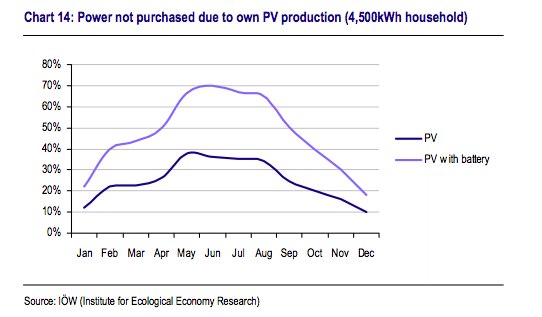 |
| И ето същото нещо, но с примери: Натисни тук Gehrlicher Solar AG 's (Neustadt b. Coburg, Germany) Spanish subsidiary has completed a mini-grid powered by a 30 kilowatt (kW) solar photovoltaic (PV) array on a rural residential estate in the Murcia Region of Spain. The nine houses in Cañada Lentisco were not previously connected to the grid, but will now be powered by 90 PV modules on the roof of a farm building, eight SMA inverters and a battery system. Gehrlicher states that the project is a model for other rural electrification projects in Spain. "Steady increases in fossil fuel prices, coupled with continuous increases in electricity prices, are now making stand-alone energy supply systems a good cost-saving solution for industrial as well as private consumers," states Gehrlicher Solar. "Independence from energy providers is a further key benefit, protecting companies and families from increasing electricity prices for a minimum of 30 years, the life expectancy of the installation." | |
Редактирано: 1 път. Последна промяна от: Distributed |
затова и се доверявам на специалистите, като тези енергийни експерти от швейцарската банка UBS: Както писах в друга тема - напоследък вярата ми в енергийните експерти на разни банки е силно подронена. |
| Калки Твое право. Само че горната система от фотоволтаици и батерии за вътрешна употреба е факт. Съществува и е построена без субсидии, без преференции, без никаква държавна помощ. А с поевтиняването на хардуера такива ще станат масови, за което и става дума в този доклад. А ти, ако искаш го игнорирай целия този процес, ама после да не стане както стана с ДКЕВР: "Ами не знаех, че ВЕИ ще поевтинеят толкова много толкова бързо. Кой да предположи?!?!". Информиран си. | |
Редактирано: 1 път. Последна промяна от: Distributed |
| Абадабчо, приятно четене ... дали всичко е така, както раздуваш? Източник - Spiegel, не някое жълто или субсидирано издание... Макар и политически окрасено и от всички оспорвано, самото политическо предложение е показателно... By SPIEGEL ONLINE Staff Environment Minister Peter Altmaier wants to limit the cost of Germany's green energy revolution by capping subsidies for renewable energy. The plan, aimed at halting a recent surge in electricity bills, faces likely rejection from a political opposition that views the move as a clever ploy to win votes in the next election. German renewable energy investments may be about to get riskier. German renewable energy investments may be about to get riskier. German Environment Minister Peter Altmaier, a close ally of Chancellor Angela Merkel, has landed a coup that could score points for the conservatives in the September general election -- at the cost of slowing down the country's switch to renewable energy. In a surprise announcement on Monday, he said he would draft legislation to cap subsidies to renewable energy producers in order to stop the recent sharp increase in electricity bills caused by those subsidies -- a potentially popular move in an election year. "It is not acceptable that electricity consumers should keep bearing all the risk of the future costs on their own," Altmaier told a news conference. The current system works like this: Germany wants to boost its power generation from wind, solar and biogas plants, but the electricity they produce remains more expensive than coal and nuclear power. To encourage investment in renewables, the government allows operators of such plants to sell their electricity at a guaranteed fixed price or feed-in tariff that is above the market price. Energy consumers pay the difference via a renewable power surcharge on their electricity bills. To date, there has been no upper limit on Germany's subsidies for renewables, which means that the more solar panels and wind turbines go into operation, the higher the surcharge that consumers have to pay. The guaranteed high return has led to a boom in investment in renewable energy in recent years. This has boosted the surcharge to a record 5.28 cents per kilowatt hour of electricity this year, up almost 50 percent from 2012 and up from just 0.88 cents in 2006. An average German household currently pays €180 ($242) per year to subsidize renewable energy. Controversial Power Price Hikes The rising electricity costs risk undermining public support for Merkel's energy revolution, a bold program to wean Europe's largest economy off fossil fuels and nuclear power. The government, which announced a rapid exit from nuclear power in 2011, aims to boost renewables to 40 percent of power generation by 2020 from around 25 percent at present. Controversy over the sharp rise in power prices resulting from the green energy plans has been compounded by exemptions allowing power-intensive companies such as steelmakers, paper manufacturers and chemicals firms to pay lower surcharges on their electricity bills. Altmaier said he wants to cap the surcharge at 5.28 cents through 2014 and to limit its rise to 2.5 percent per year from 2015. "We've reached a limit," he said, adding that the plan amounted to a "paradigm shift." His plan includes a number of measures that could unsettle investors in renewable power plants: • Feed-in tariffs could be suspended by a certain number of months for newly installed systems, saving a potential €500 million per year. • An "energy solidarity tax" would seek contributions from owners of existing renewable installations and generate up to €300 million per year. • Exemptions for power-intensive industries, which currently amount to €4.3 billion, would be curbed, potentially saving a further €500 million. • Households and firms that generate their own power would be required to pay the surcharge in future. At present, they are exempt from it. Legislation Faces Big Hurdles Altmaier wants the legislation to be passed by Aug. 1. However, it has yet to be approved by Economics Minister Philipp Rösler, chairman of the pro-business Free Democratic Party (FDP), junior partner to Merkel's conservatives in the center-right coalition. Rösler praised the plan on Monday but stopped short of giving it his blessing. And even if Altmaier gets the go-ahead from the FDP, the law could be blocked by the opposition Social Democrats and Greens who have a majority in the Bundesrat, Germany's upper legislative chamber. Industry and environmental lobby groups criticized the plan, saying it would undermine investor confidence. "We mustn't endanger the competitiveness of the energy-intensive companies," said the president of Germany's DIHK federation of chambers of commerce, Heinrich Driftmann. Meanwhile, environmental group BUND said Altmaier was putting investment at risk by making the returns more uncertain. The Federation of Renewable Energies (BEE) agreed, saying the move would "massively unsettle" investors. The SPD and Greens also rejected the proposals, in a sign that Altmaier will have a tough time getting them through parliament. "It's a transparent maneuver," said SPD chairman Sigmar Gabriel. "It will have massive consequences for the green revolution, it hasn't been thought through." Political Coup In terms of campaign tactics, Altmaier's plan is a clever move because it could wrongfoot its various opponents. For example, despite their criticism, the Greens will find it hard to argue against cutting privileges for the big energy-hungry industries. By cutting those privileges, he will deprive the Greens of an election issue. He also outflanks the FDP on one of their pet issues, consumer protection, by defending the interests of households. In the likely event that the legislation will be rejected in parliament, Altmaier will be able to tell voters: "I tried. But the FDP, SPD and Greens didn't let me." Politically canny though his proposals might be, they have a number of flaws in terms of their impact on the energy sector. The plan for an energy solidarity tax and for a temporary suspension of the feed-in tariffs for new plants could put a serious brake on the expansion of renewable energies, or at least make it more expensive, because banks would be likely to add a risk premium to the interest they charge for credit. So the money that electricity consumers save in the process will end up being paid by investors and project managers. It might make more sense just to cut the subsidies outright rather than doing in in a roundabout way that could open the government up to lawsuits from investors who had put up plants expecting a stable return. German commentators said the plan is risky. "In the future, the investor in a wind farm will be in the same position as a landlord who is only entitled to receive rent from his tenants once they have a job, wrote the center-left Süddeutsche Zeitung newspaper on Tuesday. "Investment security: zero. The initiative could end up stopping the expansion of renewables." Even if parliament blocks the law, Altmaier will benefit politically, the newspaper said. "If the renewable power surcharge rises again in autumn, shortly before the election, it would be easy to identify the culprits -- the people who blocked his law." |
| проф. дървингов Ще го коментирам това предложение на министърът на Меркел, като намеря време тия дни. Междувременно поредния поздрав от Китайската Комунистическа Партия за родните Атомици: Натисни тук China to Boost Solar Power Goal 67% as Smog Envelops Beijing China plans to increase its goal for solar-power installations in 2015 by 67 percent to reduce reliance on fossil fuels blamed for greenhouse gases and as smog in Beijing reached record hazardous levels this month. The world’s biggest emitter of carbon-dioxide plans to raise the solar target to 35 gigawatts by 2015 from 21 gigawatts set last year, boosting demand for manufactures that suffer from slowing sales in Europe, Shi Dinghuan, the counselor of China’s State Council and the president of Chinese Renewable Energy Society, said today by phone. | |
Редактирано: 1 път. Последна промяна от: Distributed |
| проф. дървингов Понеже не съм толкова навътре в предизборните игри в Германия ето ти няколко анализа по повод предложенията на Rösler и Altmaier: http://www.renewablesinternational.net/altmaier-proposes-freezing-renewables-surcharge-at-current-level/150/537/60192/ http://www.germanenergyblog.de/?p=12112 http://www.germanenergyblog.de/?p=12056 http://www.pv-magazine.com/opinion-analysis/blogdetails/beitrag/germanys-federal-environment-minister-cannot-halt-solar-development_100010072/#axzz2JwVqMIxH |
| абадабчо, писна ми от тия простотии - дава ти се материал, иска се мнението ти (материалите противоречат на твоите твърдения) и ти праскаш половин дузина статии - няма да ги чета - очевидно е, че нямаш никакви полезни аргументи за да защитиш тезите си - дерзай! |
| Сега малко по същество Ето последните цени на PV модулите от Китай: Натисни тук  Излезе следната прогноза за 2015та (само две години напред), на която очевидно отбор Втора Атомна няма да повярва, защото те по принцип не вярват на нито една прогноза за ВЕИ, защото..... ?!?!. : Натисни тук Top Chinese Manufacturers Will Produce Solar Panels for 42 Cents (30 евроцента) per Watt in 2015  Игнорирайте прогнозата за 2015, но обърнете внимание как е намаляла последните няколко години: The cost of producing a conventional crystalline silicon (c-si) solar panel continues to drop. Between 2009 and 2012, leading "best-in-class" Chinese c-Si solar manufacturers reduced module costs by more than 50 percent. And in the next three years, those players -- companies like Jinko, Yingli, Trina and Renesola -- are on a path to lower costs by another 30 percent. И сега пак да се върнем на първа страница и таблицата за изплащане на фотоволтаика, като го ползваме само за вътрешна консумация: 0.30 евроцента/Wp за модули + inverter 0.10 евроцента/Wp + 0.10 евроцента/Wp за друг хардуер = 0.50 евроцента/Wp само за хардуера през 2015, те 1000 лева/1kWp През 2015 - прогноза, на която може и да не вярвате, но треда ще си е тук и 2015 и ще можем да си го проверим това | |
Редактирано: 2 пъти. Последна промяна от: Distributed |
| проф. дървингов мнението ми е, че това са предизборни кьорфишеци, които няма да минат през тяхния парламент и Рьошер само се опитва да спечели гласоподаватели. И че нищо няма да се промени в Германия. Дори и да махнат всички преференции - ПАК - ще имат супер много голям пазар на фотоволтаици за вътрешна консумация, ако беше прочел доклада на UBS щеше да го знаеш.... Много рано е да кажем какво от тези предложения реално има шанс да се рализира и какво не, но до изборите ще се разбере. До септември ще знаем. P.S. прави впечатление, че въпреки 3.5 години ГЕРБ не се научихте да различавате "предложение" от "окончателно приет закон и наредба". Не свикнахте ли на герберастическите номера - първо да казват какво имат намерение да направят и едва след като обиколи няколко пъти медиите да решат какво да се прави. Абсолютно същото и е с тези предложения. | |
Редактирано: 2 пъти. Последна промяна от: Distributed |
| Още едно интересно проучване на реални данни, не прогнози - реални статистически данни от официалните източници. Real world data: Натисни тук The impact of solar PV in South Australia was recognised by a special study by the Australian Energy Market Operator last August. As we reported then, South Australia had some 267MW of rooftop solar as at June 30, representing one in five households. AEMO said rooftop solar was accounting for 2.4 per cent of overall demand, and more than one-third of the PV systems were operating at the time of peak demand at any one time. Но графиките говорят сами за себе си: За годината:  За лятото в Австралия:  Екстраполация, т.е. ако това, което е станало последните 5 години стане и следващите 5 години:  Това няма да подмине и ЕС и Балканите... |
| ...абадабчо, ако имаш да речеш нещо по същество - кажи, иначе замълчи ... да не речеш сега, че и това е предизборна пропаганда както се изказа преди време по повод предложенията на германския министър ... вярно, ти агитираш за волтаици, ама там е същата боза, че и по-лошо... By Joel Stonington in Vienna A darker future for wind energy around the world? The debt crisis is finally catching up with wind energy, once a fast-growing sector in Europe. After more than a decade of double-digit growth, austerity, rapidly changing energy policies and skittish investors are putting a damper on the industry. It is often the elephant in the room at any conference on renewable energy. Sometimes, it's mentioned simply as the "s" word and other times it's not mentioned at all. But subsidies remain crucial, with wind energy still struggling to achieve price parity with coal and natural gas. This week in Vienna, at the European Wind Energy Association's annual conference, subsidies came up right away. His argument was simple. Renewable energies right now are suffering from a dual problem: Governments around the world are slashing aid for clean energy, and massive subsidies propping up the fossil fuel industry are making it impossible to compete with the cheaper energy. The current global total in fossil fuel subsidies for 2011, according to Birol, was $523 billion. The result was an incentive equivalent to $110 per ton of carbon emitted. In comparison, global subsidies for renewables amounted to what seems like a paltry $88 billion in the same year. "If we had an ideal world -- with no subsidies for nuclear, gas or coal -- in that world, onshore wind would do extremely well," Christian Kjaer, CEO of the European Wind Energy Association, told SPIEGEL ONLINE. "But that's a utopia." Wind Power Still Growing, But for How Long? Even in an uneven playing field, the wind industry has been growing rapidly in recent years. There are now 22 countries with at least a gigawatt of wind power installed (enough to provide electricity to 200,000 homes). In the European Union, countries installed 11.6 gigawatts of new energy capacity last year, up from 9.4 gigawatts put in place in 2011, according to the European Wind Energy Association (EWEA). Wind has long since become a mainstream player in the global energy market. The problem is that the gains Europe made this year came mostly from orders placed before the debt crisis that has gripped Europe since 2010, Kjaer said. And if national policies aren't adjusted to reflect a changing reality, the growth rate is expected to drop to 6 percent by 2020 and 4 percent by 2030, according to a report released in November by Greenpeace and the Global Wind Energy Council. Germany has fared well in the crisis itself, but it has had its own share of problems with renewables, with electricity prices for consumers surging as a result of the government's Energiewende, a policy of phasing out nuclear energy and increasing reliance on green energy approved by Chancellor Angela Merkel's government in response to the Fukushima catastrophe. Last month in Berlin, Environment Minister Peter Altmaier announced he would seek to stop the swift rise in electricity costs by capping subsidies on renewable energies -- a move that, while possibly helping consumers, could also adversely impact further growth in the wind power market. Political observers called it a bald political ploy to gain votes in the upcoming national election. Despite his announcement, however, most observers felt it was unlikely Germany would change its course. And support within Merkel's coalition government for his proposal is also limited. Nevertheless, the announcement is precisely the kind of thing that spooks investors. Regulatory Uncertainty "Who here believes regulatory uncertainty is the main hazard to growth of wind going forward?" asked Thomas Pütter, chairman of Ancora Finance Group, while onstage at the EWEA annual conference. Nearly every hand in the room went up. In tough economic times, politicians are looking at every little thing to cut. And high energy prices have made renewables a target for politicians looking to score points. Germany's current laws allow renewable energy producers to feed electricity into the grid at a fixed, above-market price, called a feed-in tariff. The goal of the law was to encourage investment and help bring the cost of energy from technologies like solar panels and wind farms into fair market competitiveness with coal, nuclear or gas. Renewables in Germany and other countries with feed-in tariffs have boomed, with a corresponding cost to consumers for the subsidies. Across Europe, the battles are loud and bitter on policy issues surrounding energy. "At times of distress, every form of subsidy comes under pressure," David Jones, the head of renewable energy for Allianz Capital Partners, told SPIEGEL ONLINE. The group has 42 investments in wind worth €1.3 billion. Jones said that the key for investors such as Allianz is stability in the investments moving forward. He noted that the difference in risk between European countries has grown, with the possibility of making more money in riskier countries and also a higher possibility of losing it. With wind, the initial capital investment is especially important. And the political uncertainty surrounding subsidies can have a negative knock-on effect. With increased investment risk, the uncertainty can make borrowing money for projects considerably more expensive. This double threat appears likely to push the wind power growth into the doldrums in 2013. Confidence Crushed And although Altmaier's proposal may have the potential to create difficulty on the financing side, it is still nothing compared to the loss in confidence created when countries retroactively change feed-in tariffs. The German environment minister's own plan would not change the guaranteed price for energy produced on wind farms that have already been built. But that's not the case in a number of countries around Europe that have announced retroactive changes since the downturn. At the EWEA conference, those retroactive changes were spoken of with the kind of spite and anger usually reserved for criminals. The most commonly quoted worst-practices example was Spain. The country has spent the last few years consistently making decisions that instill a sense of horror among investors. The country introduced a retroactive feed-in tariff cut in 2008 and a 7 percent energy tax last month. And new rules governing the feed-in tariff that became law on Feb. 2 caused major drops in valuation for Spain's wind farm owners. The most recent example was Acciona SA, which recently saw a four-day drop in valuation of roughly €850 million. Trouble in Paris In recent months, nearly every country in Europe that subsidizes renewable energy has been tinkering with changes or rewriting regulation in a haphazard way. The French government set up a successful feed-in-tariff to provide demand for energy from wind but later loaded it down with stifling bureaucracy. Wind energy projects must now slog through a process that can take five or six years before they get approved. Further, France's feed-in-tariff has been bogged down by an anti-wind advocacy group called Vent de Colere, or Wind of Anger. The group calls the tariffs a form of state aid and has pursued a legal case all the way to the European Union's Court of Justice. With the uncertainty surrounding the court case, and a decision not expected until November, investment has slowed to a trickle. The result has been that, in 2012, France installed roughly half of the government-set goal for new wind energy capacity. The French Wind Association, which represents 250 companies in the industry, expects 1,000 jobs to lost by the end of the year. The association's president, Nicolas Wolff, as if giving a eulogy, said: "The French market was a promising one." Mixed Signals Just going by the numbers, last year was an exceptional one for the wind industry in Europe. More than a quarter of the new energy capacity built on the Continent was wind-based, according to EWEA, and 7 percent of Europe's energy demand is now fed with wind. However, the times of huge, double-digit gains may be over for the industry. In Europe, the failure of the Continent-wide carbon emissions trading system, which is intended to penalize CO2-heavy companies by requiring them to purchase certificates for their emissions and is thus intended to spur investment in green energies, is contributing to the growth problem. The floor has fallen out on the market for emissions certificates. Meanwhile, the US hasn't even established its own carbon trading system yet. Add to this the fact that fracking has given the country access to cheap and cleaner natural gas. Instead of burning coal, the US is now exporting it abroad and driving global market prices down. With no real price on carbon and mass fossil fuel subsidies to the tune of $500 billion, wind power will likely stagnate. Until recently, China, with its turbo growth in wind power, could be relied upon as a major driver of global growth in the sector, but even there the market is stalling. And the Global Wind Energy Council's "Wind Energy Outlook" suggests that developing markets like Brazil and India are unlikely to fill the gap. For those in the wind industry, it's the financing that matters the most. And for those with the money, volatility very simply means greater risk. Even high-level comments that serve as a political foil can mean lead to millions of euros in additional costs for a single new project. "If you want to attract investments," Kjaer commented. "You can't send mixed signals." |
| проф. дървингов ...абадабчо, ако имаш да речеш нещо по същество - кажи, иначе замълчи ... да не речеш сега, че и това е предизборна пропаганда както се изказа преди време по повод предложенията на германския министър ... вярно, ти агитираш за волтаици, ама там е същата боза, че и по-лошо... Изказването на германския министър Е предизборна пропаганда, но изглежда нещо пречи да го разберете А и зз не агитирам за волтаици, аз агитирам за енергийно независими граждани - "Независими граждани = Независима Държава" - а това за сега може да стане само с ВЕИ, но не и с АЕЦи и енергийни монополи и добавки и още копаене за шистов газ или въглища.А сега относно публикацията на Шпигел. Изглежда и нея я четете като дявола евангелието. And if national policies aren't adjusted to reflect a changing reality, the growth rate is expected to drop to 6 percent by 2020 and 4 percent by 2030, according to a report released in November by Greenpeace and the Global Wind Energy Council. Чудо голямо не са бебета - да се оправят. Само, че предполагам имате акъл в главата, за да разберете лицемерието на призиви да се махат субсидиите, фиксираните изкупни цени, държавно гарантираните заеми и т.н. политическа парична и непарична помощ за ВЕИ без да се настоява паралелно с това да се махат същите неща за АЕЦи и изкопаеми горива Или нямате Никой не знае.Истината е, че ВЕИ вече нямат нужда от субсидии, но да се премахнат субсидиите само за ВЕИ е пълно лицемерие Дано го разбирате.Ето становището на AEWA относто американските субсидии: Натисни тук Wind Industry Calls for 6-Year Phaseout of PTC Subsidy Incentive-free wind is two innovation cycles away. Herman K. Trabish: December 13, 2012 The American Wind Energy Association (AWEA) sent a letter to Congressional leaders accepting a six-year phase-down of its vital production tax credit (PTC) in return for getting it extended at 100 percent of its present value for projects started next year and 90 percent for projects placed in service in 2014. The tax credit of $0.022 per kilowatt-hour of electricity for the first ten years of a turbine’s production is estimated to have leveraged $15.5 billion in private investment in wind over the last five years. It was extended for three years as part of the financial crisis relief package of 2008 and led to growth through the recession. The PTC has allowed the industry to establish “a stable base market” on which “further market and technology innovation” over the next six years will, if the industry is properly supported, become competitive without the incentive, AWEA’s letter announced. From “detailed economic analyses and high-level discussions with industry leaders,” AWEA’s letter noted, the industry requires only a stable, predictable phase-down of its federal incentive over an adequate timeline. AWEA recommended taking the PTC down to 80 percent of its present value for projects placed in service in 2015, 70 percent for 2016, and 60 percent for 2017 and 2018. Самата индустрия го иска и след това - довиждане АЕЦи, довиждане въглища, довиждане ТЕЦове на шистов газ - вятърните паркове в централните щати ще правят най-евтиния ток въобще, а там има щати с потенциал за 400-500 гигавата. Например Тексас - 500 GW Натисни тук или Канзас 950 GW (деветстотин и петдесет гигавата) Натисни тук Така, че целия спор за субсидиите ще се обезсмисли до няколко години, когато самата ВЕИ индустрия ще призовава да се махнат, за да може да си подобри имиджа и да се отърси от впечатлението, че не може без субсидии | |
Редактирано: 3 пъти. Последна промяна от: Distributed |