Военни новини / Defence News
Отиди на страница:

Онзи, постарайте се да научите колко пилоти от гражданска авиация са били бивши военни пилоти, ако продължавате да пледирате за "компетентност" в това пространство, а ако искате да спорите за АйПи адреси, има отделна тема.  Вече ви го казах и мисля, че не пиша на английски, за да не ме разбирате. Вече ви го казах и мисля, че не пиша на английски, за да не ме разбирате. |
мисля, че не пиша на английски, за да не ме разбирате. ъ? нарочно не пишеш на английски, за да не те разбирам? браво. так держат  а щом смяташ, че военните пилоти не стават за граждански такива - добре. както се съгласих с летящите ип адреси, така се съгласявам и с това. да. друго си е да те просвети компетент  |
| Загубили сте чувството за хумор и се вживявате много, а и чатът е проблемът. На испытаниях в Комсомольске-на-Амуре потерпел крушение новейший российский истребитель Су-35, пишет Lenta.ru со ссылкой на слова Виталия Тюлькина, советника гендиректора по связям с общественностью Комсомольского-на-Амуре авиационно-производственного объединения, осуществляющего производство самолетов компании "Сухой". "Авария произошла в 9:55 (по московскому времени) в воскресенье на аэродроме "Дземги" при рулежке и пробежке опытного изделия Су-35," - сообщил Тюлькин. Пилоту, летчику-испытателю Евгению Фролову, удалось катапультироваться.  |
von_Newmann 05 Апр 2016 23:25Мнения: 1,434 От: 0Скрий: Име,IP Загубили сте чувството за хумор и се вживявате много, а и чатът е проблемът.  | |
Редактирано: 1 път. Последна промяна от: Majorov |
Авария произошла в 9:55 (по московскому времени) в воскресенье на аэродроме "Дземги" при рулежке и пробежке опытного изделия Су-35 Ама, Нюмане, нали катастрофи по време на изпитания не влизаха в сметката, бе? Забрави ли вече какво пледираше малко по-назад в същата тема? |
| 87 nuclear warheads more today than in September Russia has 185 strategic warheads more than limited by the New START agreement. That is nearly the number on-board the Northern fleet’s two Borei-class submarines. The figures do not reveal how many warheads are on board submarines, heavy bomb planes or in silo-based missiles. It is, however, likely that the increase in warheads mainly are on board submarines that sail out from the Northern fleet’s Gadzhievo base on the Kola Peninsula. http://thebarentsobserver.com/2016/04/87-nuclear-warheads-more-today-september |
Ама, Нюмане, нали катастрофи по време на изпитания не влизаха в сметката, бе? Щом са руски се броят, за да ги изравним горе-долу с американските, които са паднали, щото последните са много. Е, има малко демагогия в моите съобщения, но животът е демагогичен. |
| Kоето си е право, право си е - живота е демагогичен и пълен с лицемерие. Та след като така ще броиш руските загуби, Нюмане, ето ти още една бройка от мен. Каспийский монстр: история мощнейшего советского экраноплана 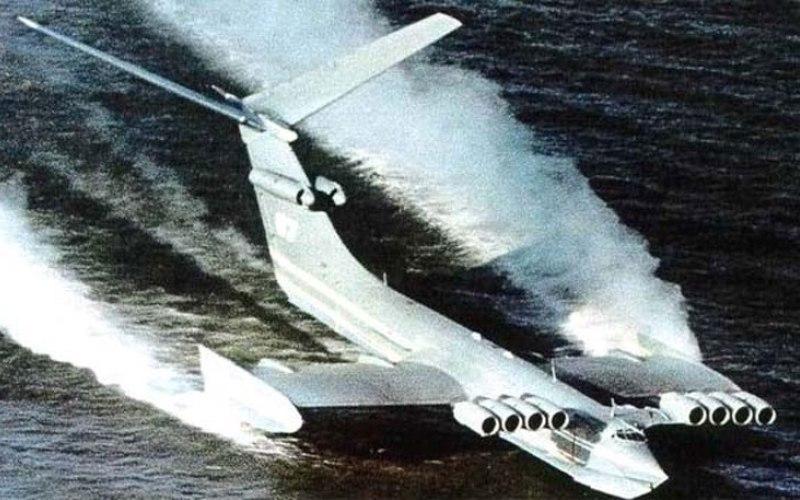 |
| Ноймане, с целия полагащо се уставен респект искам плахо да попитам оная тапия, издадена от някаква агенция не се ли отнася само за пилоти любители? Има литературни данни, че американските авиолинии с мерак приемат военни пилоти (след съответната преквалификация) стига да са в съответното функционално състояние. Особено пилоти от военно-транспортната авиация. Моля за компетентен и професионален отговор. Благодаря. |
2016 - ARMATA T-14 WINTER TEST DEMONSTRATION *** HD https://www.youtube.com/watch?v=cTlErpzDTOI |
| Челеби Нойман, а инфо от времето на дядо Адам ще дадеш ли? Щото тази за катастрофата на Су-35 е от 2009 г. Да не говорим, че не даваш пълната информация: Кроме того, Тюлькин подтвердил информацию, опубликованную в газете "Взгляд", уточнив, что "авария произошла в 9:55 (по московскому времени) в воскресенье на аэродроме 'Дземги' при рулежке и пробежке опытного изделия Су-35". Пилот машины, летчик-испытатель Евгений Фролов, не пострадал - ему удалось катапультироваться; жертв на земле нет, добавил Тюлькин. + Информация о крушении прототипа новейшего российского истребителя Су-35-4 появилась в СМИ в ночь на понедельник. Сообщалось, что Су-35 новейшей модификации взлетал с заводского аэродрома в Комсомольске-на-Амуре, однако в конце разбега самолет столкнулся с неким препятствием, в результате чего полностью разрушился и сгорел http://www.meta.kz/97067-Комиссия-расследует-обстоятельства-крушения-Су-35-в-Комсомольске-на-Амуре.html |
| Още едно кратко клипче с "Армата", от 2015 «Армата» ведет огонь: кадры из боевого отделения https://www.youtube.com/watch?v=TQLG0bOy7SY | |
Редактирано: 1 път. Последна промяна от: Doziris1 |
| Е тука една еврейска дискусия за тоя танк Армата. Не е проста машинка. https://www.youtube.com/watch?v=xQv564lopcY&nohtml5=False |
| Saudi royals involved at highest levels in 9/11 attacks US President Barack Obama will decide whether to declassify 28 pages of sealed documents — which some suspect show a Saudi connection to the 9/11 attacks — within 60 days, according to a former senator who co-chaired the 2002 joint congressional inquiry into the attacks. Former Florida Sen. Bob Graham told Fox News late Tuesday that the White House had informed him that a decision on whether to declassify the documents would be made in one to two months. Graham, who has pressed for the documents to be made public, told Fox he was “pleased that after two years this matter is about to come to a decision by the president.” Both the George W. Bush and Obama administrations have refused to unseal the documents, claiming it would jeopardize national security. Critics claim the reluctance is a calculated move to hide Saudi Arabia’s involvement in the attacks that killed almost 3,000 people. https://www.almasdarnews.com/article/saudi-royals-involved-highest-levels-911-attacks/ | Al-Masdar News |
| Ноймане, ето ти нещо мноооото дълго (ще прощаваш), но пък поучително, идва петък - ден на майсотра, след това викенд - предлагам да щудираш материала и евентуално да си поговорим, а? Натисни тук Russia’s military resurgence and implications for the NATO Alliance By Filip Tuček. Photo: Ministry of Defense of Russia 11. Apr 2016 Myths about Russia’s military might (or lack thereof – depending on the source) have flooded the public space. It is on high time to remove the cloak of mystery, analyse facts, and look objectively into how Russia has sought to rebuild its armed forces. The better understanding of both Russia’s military achievements and limitations is vital to make optimal policy decisions, not least at the July NATO Summit in Warsaw. First, the article uncovers and contextualizes Russia’s strategic planning to explain what type of armed forces the country’s political and military leadership desires. Second, it analyses the actual reforms to provide insights into Russia’s current and future plans. Finally, the text examines whether Russia has the ability to put the reformed military into action and to carry out the envisioned plans. Russia’s vision of its military Russia has never ceased to perceive NATO as a threat, dangerously enlarging and unlawfully deploying equipment and forces ever-closer to the Russian borders.[1] The view is widely shared across Russia’s political, military, and expert elite circles.[2] Sergey Yermakov, Deputy Director of the Russian Institute for Strategic Studies tasked with providing foreign policy advice to Russia’s leadership, calls for a ‘complex response’.[3] This sought-after strategy requires a formidable military force. In Russia’s vision, current and future both asymmetric and conventional warfare requires well-trained, rapidly deployable forces, supported by quick decision-making and inter-agency coordination. These developments indicate a shift from the old focus on mass force, to one equipped with complex systems, and capable of reacting to a diverse set of scenarios.[4] The growing role of military power in Russia’s foreign policy thinking is supported by legislative changes. The 2009 amendment to the Law on Defence has expanded legal options for dispatching the armed forces abroad beyond counterterrorism and peacekeeping to include a response to an attack on Russian citizens abroad, and assistance to another state by request of its leadership to prevent or repel an attack. The first justification was used by the Kremlin in Crimea, the second in Syria.[5] While Crimea demonstrated Russia’s ability to swiftly deploy special forces, airborne troops, and naval infantry, and amass between 40,000 and 90,000 troops on the border for several months, Syria points to the ability to dispatch troops and hardware on long distances and conduct joint air and naval operations.[6] Beyond new cannons The envisioned modern military force needs appropriate equipment. No longer should ageing tanks struggle to leave their bases and aircrafts be unable to take off from cracking runways. In the mid-2000s, much of Russia’s military equipment had become obsolete and the low level of investment into new one could not make for the attrition. The number of outdated arms grew fast. In 2006, modern military hardware represented less than a fifth, compared to NATO’s estimated 70%.[7] As Russia politically stabilized and it’s GDP – driven up by high commodity prices – doubled, the leadership decided to reverse the trend. The restored military might should help Moscow get back where it, in its own view, rightfully belongs – among major powers. The 2011-2020 Strategic Armament Plan (SAP) allocates $700 billion to increase the proportion of advanced weapons in the inventory of all branches to 30% by 2015 and to 70–80% by 2020.[8] Perhaps surprisingly for some, Russia has in many aspects exceeded the interim 2015 target.[9] This is true particularly for equipment for which domestic industries have mastered all technical aspects and hence have not been so badly impacted by the restricted access to Western technologies due to the sanctions. Given the current economic slowdown, it is likely that the SAP will be underfunded, with non-critical programmes extended to the post-2020 period, scaled down or cancelled; a fact acknowledged even by the Russian Defence Minister Sergey Shoigu and hinted by the recent 5% defence budget cut proposal.[10] However, the total 2015 military expenditure of 5.4% of GDP offers space for cuts and even if the SAP remains unfulfilled, the Russian forces have already achieved strong combat capability.[11] While the ability to conduct a complex, multi-force prolonged expeditionary campaign remains unclear, Moscow has demonstrated sufficient capabilities to launch and sustain a limited campaign. The Army is being equipped to operate in diverse and operationally challenging territories, from the Middle Eastern deserts to the post-Soviet space to the Arctic. Units are being equipped with high-tech vehicles and modern, highly maneuvarable and heavily armoured tanks such as T-14s.[12] These should make the army very mobile and capable of engaging a highly developed adversary in a conventional confrontation. On the technological side, Russia has dramatically enhanced its electronic warfare (EW) capabilities, and has attained around a 1,000-strong fleet of non-lethal unmanned aerial vehicles (UAVs). These assets strengthen the military’s ability to conduct complex operations, increase its resilience in contested environments, and enhance early warning and situational awareness. The 2008 war in Georgia in many ways revealed the insufficient technological state of the Russian armed forces. The use of critical capabilities for modern operations, UAVs and EW, was minimal and ineffective. At present, Russia’s advances and extensive use of UAVs and EW capabilities has made countering them one of NATO’s priorities to strengthen Ukraine’s resilience and prepare itself for a potential contingency on the Eastern flank.[13] Priority is also given to advanced missile systems such as the anti-aircraft S-400s (range of 400 km) and the modernized ballistic Iskander-Ms (range of 500 km), both capable of hitting targets deep in Europe.[14] In response to NATO’s ability to conduct large scale airspace operations, Russia has been contemplating deploying S-400s and Iskander-Ms near the Baltic Sea, in Belarus, and in Crimea, where they could directly threaten NATO’s missile defence and air space.[15] Deployments of Iskander missiles configured to have a range over 500 km would violate the 1987 Intermediate-Range Nuclear Forces (INF) Treaty. The INF Treaty, which bans all land-based ballistic and cruise missiles with ranges between 500 and 5,500 kilometres, has been considered an important, even if fragile, pillar of European security.[16] The combined capabilities of S-400s and Iskander-Ms, reinforced by other Russian missile systems deployed in Kaliningrad, would impede theatre entry for NATO forces and compromise the ability of the Baltic States and Finland to operate within and around their respective territories.[17] The enhanced Russian capabilities and the insufficient rocket artillery systems of regional NATO Allies mean that restoring NATO’s air superiority over its eastern flank might take up to weeks and would require a highly complex multi-national operation.[18] S-400s employment during the Syrian campaign underscored Russia’s ability to counter NATO’s preponderance of power by improving its anti-access/area-denial (A2AD) capabilities.[19] Since the early years of the Cold War, Russia deploys a triad of strategic delivery systems capable of delivering hundreds of nuclear warheads. Russia boasts intercontinental ballistic missiles (ICBMs) both in fixed-silo and mobile configurations, strategic missile submarines, and bombers capable of delivering air-launched cruise missiles.[20] Currently, Russia has been in the midst of a major nuclear modernization programme focusing on both ICMBs and submarines capable of launching missiles with nuclear warheads. Russia has recently reinforced its strategic rocket forces by deploying over 30 modernized road-mobile and silo-based Yars ICBMs, adding to the fielded Topol-M missiles.[21] To reinforce the other two components of the nuclear triad, ten bombers (TU-160s, TU-95s), and two out of the planned eight nuclear submarines have been commissioned. On the defensive side, Moscow possesses a capable early warning system (however impossible it would be for either Russia or the US to meaningfully intercept a launched massive adversarial nuclear attack).[22] A key component is the satellite nuclear warning United Space System which was fielded despite delays and technical difficulties.[23] The arguably bigger threat is posed by Russia’s tactical nuclear weapons. As early as in 2000, in reaction to NATO’s conventional military superiority, Russia embraced the nuclear arms-enabled concept of ‘de-escalation’.[24] The tactics envisions a response to a large conventional attack with a limited tactical nuclear strike. The concept requires Russia to maintain an extensive arsenal of rapidly deployable tactical nuclear weapons and suggests that the threshold for Russian use of nuclear weapons could be lower than that of NATO or the US.[25] Worryingly, encouraged by the enhanced capabilities, the Kremlin has not hesitated to engage in nuclear sabre rattling. President Putin acknowledged that nuclear forces were on alert during the annexation of Crimea.[26] Meanwhile, Russian strategic rocket forces have conducted an increased number of exercises, and bombers have probed the air defences of NATO members.[27] Moving and manning the reformed military The Russian ‘complex response’ emphasizes high combat readiness. To achieve it, Moscow invests into modern command and control systems, a key component of both asymmetric and conventional warfare. The five reorganized military districts each include a joint operational strategic command to enhance decision-making. The new Moscow-based National Defence Control Centre (NDCC) should provide real-time situational awareness and facilitate centralized coordination during operations.[28] Bringing together around 50 military, police, economic, infrastructure and other authorities under the leadership of General Staff, the NDCC has the potential to be the backbone of the organizational drive towards greater flexibility, speed and inter-connectedness. The concept of unified command was for the first time tested in practice in 2015 during exercises near the Western border, bringing together land, airborne, naval, and infantry troops.[29] In practice, the NDCC played an effective coordinating role within the military command structure when Russia was dispatching its troops and aircrafts to Syria. In a crisis, the centralized decision-making could give Russia time advantage vis-à-vis NATO, where 28 Allies need to come together, overcome their differences, and collectively reach decisions. NATO political leaders’ refusal to preauthorize field commanders to take action under pre-defined scenarios, or to otherwise streamline the decision-making process, might decrease the Alliance’s ability to react on time when needed.[30] To address the perceived threat posed by NATO, Russia has reinforced its Western Military District. In 2015, the new First Tank Army and around 30 new units were introduced there, increasing the number of armies in the West to three.[31] Three new divisions and related infrastructure should follow in 2016.[32] According to the Russian ministry of Defence, around 40% of the total force is based in the Western Military District – at the proximity to NATO. As a result, Estonia, Latvia and Lithuania suffer from an even more unfavourable local military balance of power with Russia.[33] Combined, their armies have about 12,000 soldiers compared to the Russian ground forces of 250,000 soldiers and backed by aerial, maritime and nuclear capabilities.[34] Russia has also strengthened its military forces in Crimea, modernized the Black Sea Fleet, and completed the integration of former Ukrainian military units there.[35] These steps, explained as a response to NATO’s military build-up in the Alliance’s East, indicate Russia’s efforts to enhance capabilities for a conventional inter-state war on its Western border.[36] With more than 350,000 professional soldiers, Russia has for the first time achieved the ratio of 2:1 professionals to conscripts. These professionals mainly serve in elite forces such as the airborne-assault troops, special-operations forces, and submarine unites. The number of reservists declined sharply, from 20 million in 2008 to 2 million in 2014. Despite the professionalization, Russia’s armed forces still could not properly function without the draft.[37] Frequent planned and snap exercises ensure high readiness of the modernized forces. The largest exercise in 2015, ‘Tsentr’, brought together around 95,000 soldiers, 7,000 pieces of military equipment, and 150 fighter aircrafts; the largest force massed by Russia over the last quarter of a century and a massive increase from just 9,400 soldiers exercising in 2013.[38] The trained scenarios ranged from counter-insurgency and counter-terrorism, amphibious and airborne landing to conducting large-scale conventional air and ground attacks. Particular emphasis was put on enhancing strategic mobility, improving command and control, and increasing firepower.[39] For 2016, dozens of major national multi-force exercises are planned.[40] The largest one, ‘Kavkaz’, is planned for September 2016. Its purpose will be to test the joint forces’ ability to operate and move rapidly in large distances in contested environments.[41] Finally, the practice of snap exercises, which worried NATO over the course of 2015, will continue into 2016.[42] These unannounced exercises are supposed to signal to Brussels that Russia can, in the matter of hours, mass 40,000-50,000 soldiers, something that the multi-national NATO cannot.[43] Tellingly, a special focus will be given to air-supported highly mobile ground operations in contested territories.[44] Postscript: Implications for NATO ahead of the Warsaw Summit NATO should not get intimidated by Russia’s military resurgence with all its strengths and weaknesses, nor should it engage in a restless competition. Instead, a two-pronged strategy is desirable. On the one hand, NATO needs to boost defence of the contested Central and Eastern European (CEE) territories through more credible deterrence reinforced through actual capabilities deployed in the region. The proposed rotational presence of 2-3 brigade-size forces in CEE should be backed by a multi-national and rapidly deployable force in Western Europe. Additional permanently stationed NATO troops in Europe might enhance preparedness and boost the deterrence effect. Such strategy would in essence mirror the logic of the allied presence in Germany during the Cold War as a guarantee of solidarity and assurance against a surprise attack on an ally. NATO should also invest into infrastructure for effective quick forward movement in and between Member States; air strips, logistics and fuel depots, harbour modifications, and radars for enhanced early warning, will serve this purpose well. NATO forces rotating in the CEE and supported from behind the front line would deprive Russia of calculating with a quick victory, achieving the dangerous fait accompli as it happened with Crimea and Georgia. The deterring forces need to be visible, at high readiness, and able to flexibly adapt to challenges from low-intensity hybrid warfare to a conventional invasion.[45] On the other hand, the Alliance must work towards re-opening a dialogue with Russia. In the long-run, the eventual goal should be re-establishment of cooperative relations in areas characterized by shared interests. A pragmatic approach to Russia does not need to mean compromising on Western principles and values. Rather it is a matter of insightfully identifying the agenda that the West and Russia share and can work on together. Terrorism is a real threat for both Russia and the West. Similarly, tactical nuclear weapons deployed on the European territory do not ultimately leave anyone safer. While Western economies are, in general, in a better shape than the Russia’s one, many of the ongoing economic challenges will bring troubles to both Moscow and the West. Refusing to work with Russia on anything might be counterproductive. Russia’s behaviour is unlikely to positively change as a result of an increased isolation, the threat to the Alliance will not go away, and some other (that is non-Russia) threats will be harder to address. In other words, a renewal of a full-fledged Cold War seems to bring more risks than solutions. Both Russian and NATO leaders should bear this in mind when beefing up their respective militaries. Filip Tucek is Researcher at NATO Parliamentary Assembly, and external Consultant at Eurasia Group. The opinions expressed are solely his own and do not represent views of either of the two organizations. |
| Greece Conducts Military Drills Along Northern Borders Greece's military is carrying out unscheduled exercises along the country's northern borders, with fighter jets flying over an informal tent city of 11,000 migrants next to the border with Macedonia. Greek military officials say the drills, which foresee activation of rapid-response ground units and aircraft, as well as air defense units in parts of the eastern Aegean Sea, were ordered early Thursday. Over the past few days, Greece has reported a rise in violations of its airspace in the eastern Aegean Sea by Turkey's air force, and Greek fighter pilots have engaged in a series of simulated dogfights with Turkish fighter jets. Relations are also testy with Macedonia, which closed its borders to thousands of refugees and other migrants trying to move on from Greece to Europe's prosperous heartland. http://abcnews.go.com/International/wireStory/greece-conducts-military-drills-northern-borders-38386917 |
| BREAKING: US State Department says it has seen reports that North Korea is preparing intermediate-range missiles - Reuters |
 Събитията се завихриха още през януари т.г., когато: The alert was ordered by Curtis Scaparrotti, commander of the UN Command/Combined Forces Command/United States Forces Korea. Scaparrotti issued the order during a visit to the US and South Korea jointly operated Osan Air Base. “The United States and South Korea are continuously and closely having discussions on additional deployment of strategic assets,” said Kim Min-seok, spokesman at the South Korean defense ministry. The US is considering the deployment of B-2 bombers, F-22 stealth fighter jets, and nuclear submarines. There are currently 28,500 US troops in South Korea. The Republic of Korea Armed Forces is one of the largest standing armed forces in the world with a reported personnel strength of 3,600,000 with 700,000 active. И оригиналният източник --- Натисни тук Всъщност война не може да има, защото оня дюмбелин ЗНАЕ, че ще го изпепелят за броени минути и нито армия, нито балистични ракети, нито друга железария ще му помогнат. |
Saudi royals involved at highest levels in 9/11 attacks US President Barack Obama will decide whether to declassify 28 pages of sealed documents — which some suspect show a Saudi connection to the 9/11 attacks — within 60 days, according to a former senator who co-chaired the 2002 joint congressional inquiry into the attacks. Former Florida Sen. Bob Graham told Fox News late Tuesday that the White House had informed him that a decision on whether to declassify the documents would be made in one to two months. Graham, who has pressed for the documents to be made public, told Fox he was “pleased that after two years this matter is about to come to a decision by the president.” Both the George W. Bush and Obama administrations have refused to unseal the documents, claiming it would jeopardize national security. Critics claim the reluctance is a calculated move to hide Saudi Arabia’s involvement in the attacks that killed almost 3,000 people. https://www.almasdarnews.com/article/saudi-royals-involved-highest-levels-911-attacks/ | Al-Masdar News Продължението: Saudi Arabia Warns of Economic Fallout if Congress Passes 9/11 Bill WASHINGTON — Saudi Arabia has told the Obama administration and members of Congress that it will sell off hundreds of billions of dollars’ worth of American assets held by the kingdom if Congress passes a bill that would allow the Saudi government to be held responsible in American courts for any role in the Sept. 11, 2001, attacks. The Obama administration has lobbied Congress to block the bill’s passage, according to administration officials and congressional aides from both parties, and the Saudi threats have been the subject of intense discussions in recent weeks between lawmakers and officials from the State Department and the Pentagon. The officials have warned senators of diplomatic and economic fallout from the legislation. Adel al-Jubeir, the Saudi foreign minister, delivered the kingdom’s message personally last month during a trip to Washington, telling lawmakers that Saudi Arabia would be forced to sell up to $750 billion in treasury securities and other assets in the United States before they could be in danger of being frozen by American courts. http://www.nytimes.com/2016/04/16/world/middleeast/saudi-arabia-warns-ofeconomic-fallout-if-congress-passes-9-11-bill.html | |
Редактирано: 1 път. Последна промяна от: Doziris1 |
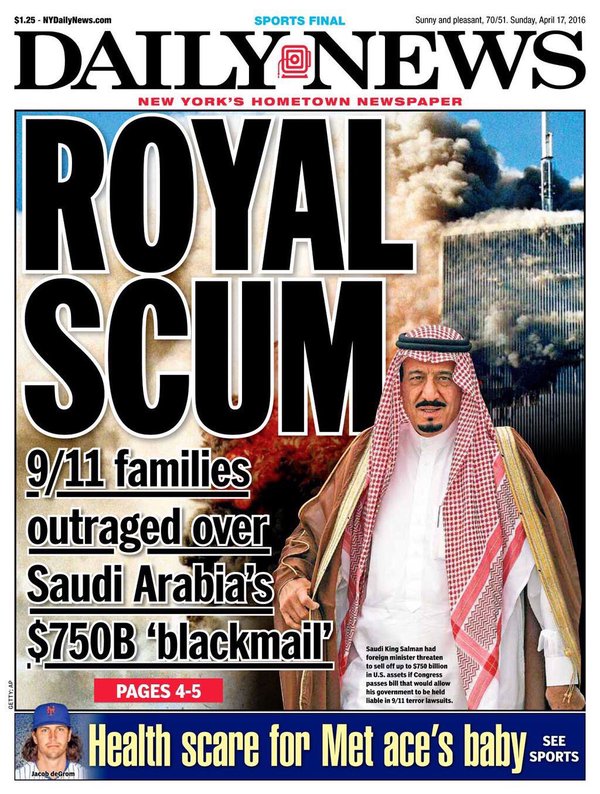 New York Daily News Verified account @NYDailyNews 6h6 hours ago TODAY'S FRONT PAGE: ROYAL SCUM 9/11 families outraged over Saudi Arabia's $750B 'blackmail' https://twitter.com/NYDailyNews/status/721696048620683264 |